Festiva Maxima vs Krinkled White Peony: Fragrance and Petal Form
"Why did my two white peonies look and smell so different after the same wet week?" A customer asked us that last spring, and the answer was in the petals and in the soil. One plant was Festiva Maxima, a fully double bloom of smooth, tightly packed petals. The other was Krinkled White, an open single with crinkled petal edges around golden stamens.
The double held the rain like a sponge and bowed. The single shed it and stood up. Scent followed a similar split, because how much a peony gives off depends on warmth and on how evenly its roots are watered.
This article talks about how petal form, rain, soil moisture and temperature shape scent and handling in these two white peonies and answers the questions customers ask us most. Read on to learn how to site each one, how to support the heavy double, when to smell the blooms, what mature crowns do, and which one suits your arranging and your soil.
Festiva Maxima and Crepe Petals in Wet Springs
Rain treats these two flowers differently because of how the petals are built. What follows is a reading of the pattern, not a laboratory result, so treat the mechanism as a well-supported guess.
How Each Petal Holds Water
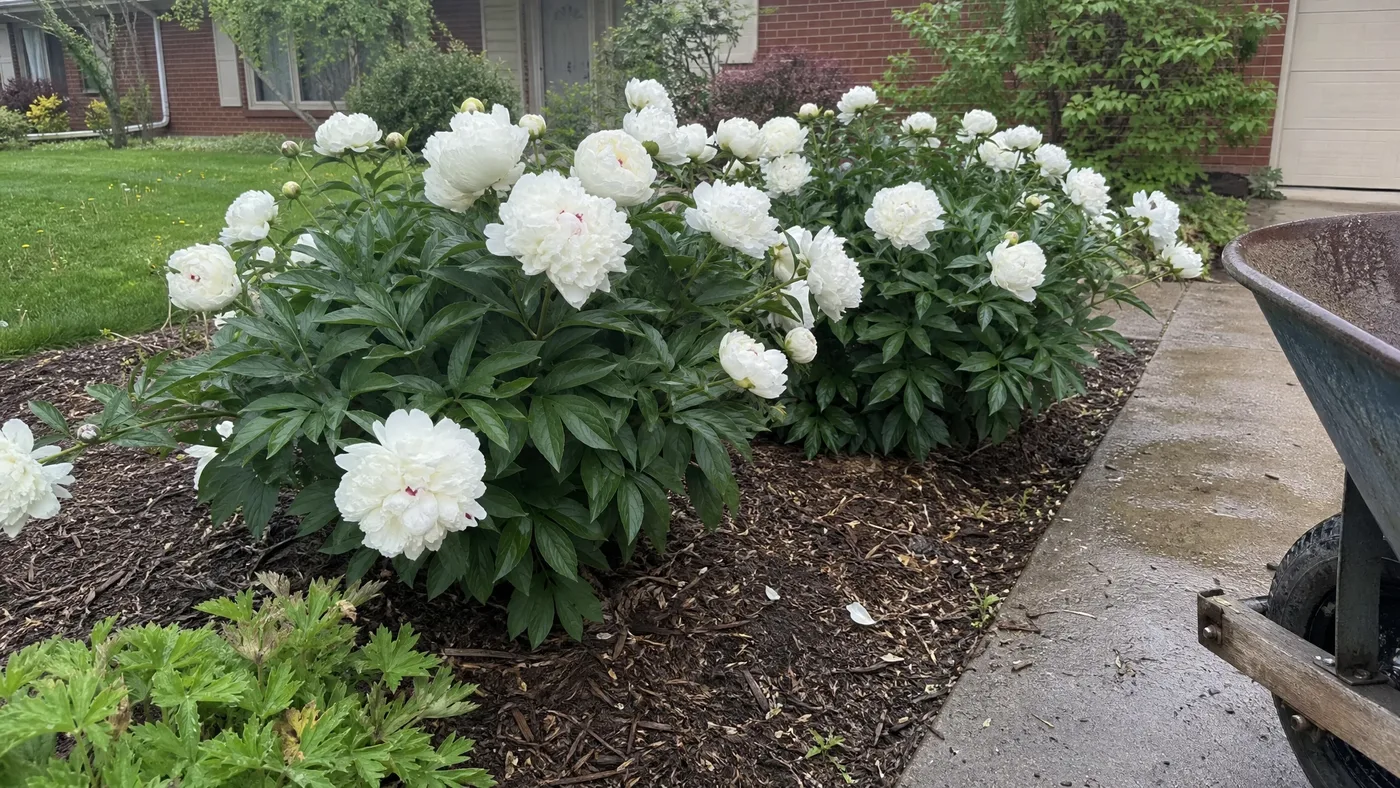
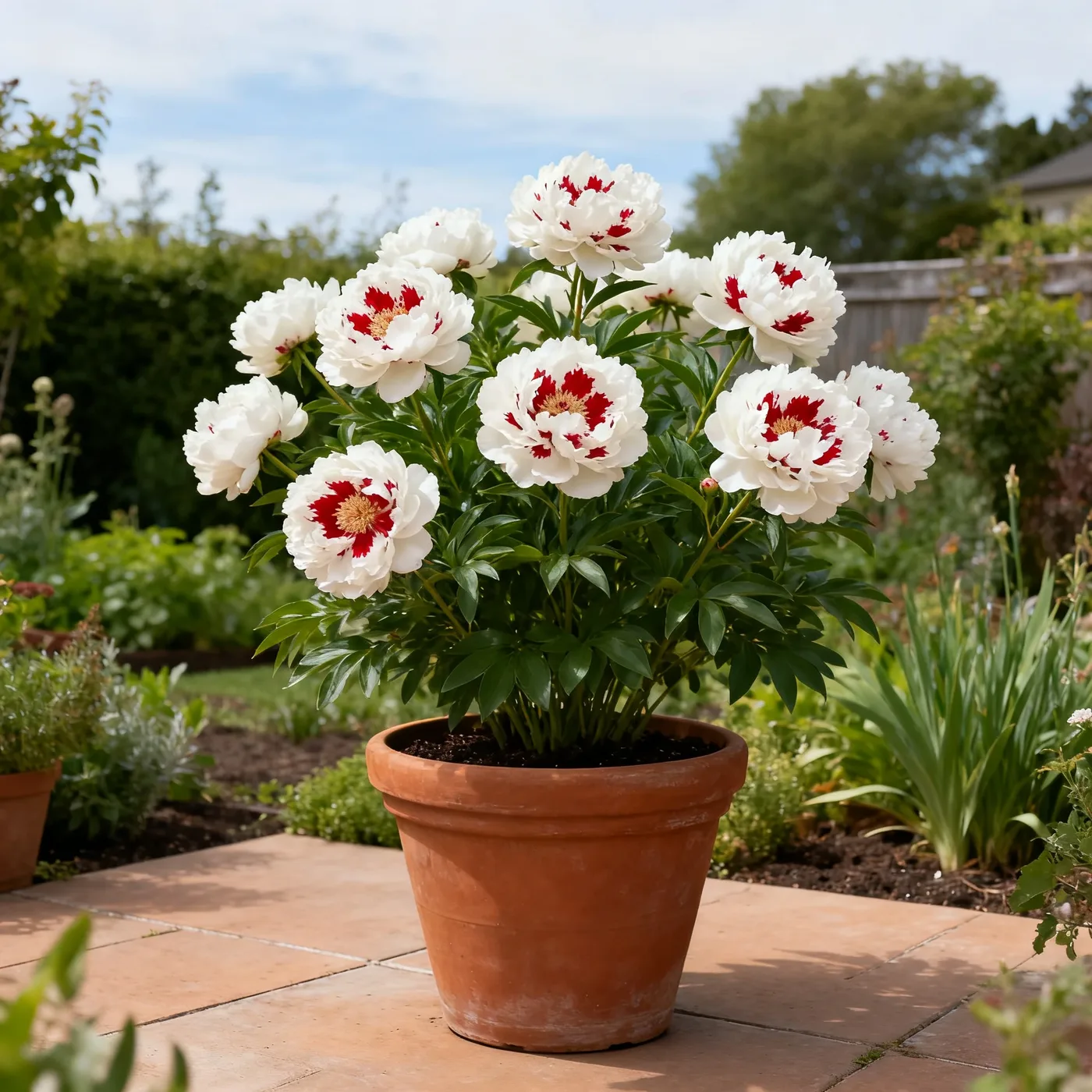
Festiva Maxima is fully double, so many smooth petals stack into a dense dome. Rain lands on the top layer, runs into the gaps between layers, and stays there because almost no air moves through the middle. Krinkled White is listed as a single, with crinkled edges on the petals and a large cluster of golden stamens in the center. Rain passes through that open cup, and the crinkled edges leave air gaps. In our rows, the doubles stayed damp and heavy long after the singles had dried.
Damp petals pressed together tend to soften and brown sooner than petals that dry within a few hours. That is why a wet week can leave a Festiva Maxima head looking spent while the single beside it looks fresh.
Siting for a Wet Spring
Give Festiva Maxima air. It wants a sheltered position, and that reads best as shelter from battering wind and not from all air movement. Choose a spot with a windbreak on one side and open space on the other, so the heads dry after a storm. The soil matters just as much, and our guide to soil, pH and drainage covers how to build it.
Krinkled White carries the opposite risk. Its open flower dries quickly, but it will not tolerate waterlogging. With the double, you protect the head. With the single, you protect the root.
What Festiva Maxima Heads Did After Heavy Rain
A soaked bomb-double weighs far more than a dry one, and that weight sits at the top of a stem on a plant about 2–3 feet tall and wide. After storms, stems bow to the ground with the head face down in the mud. Festiva Maxima may need support, and the heavy, water-holding head is the reason.
Krinkled White is different. Its stems are strong and do not need staking, which fits a flower that holds so little water. If staking is the part of peony growing you dislike, that difference counts.
Support and Spacing Steps
The simplest approach is to set the support before the weight arrives, because a hoop cannot be added neatly once the stems have flopped. We suggest this order:
- Place a hoop or grow-through grid over each crown as the shoots emerge, so the foliage grows up through it and hides it.
- Give each crown room for its full 2–3 foot spread, so neighboring plants do not hold each other's wet heads against the ground.
- Consider removing the side buds on stems that are bending. That puts all the weight in one head, but a single bigger bloom is also easier to support.
- After a storm, lift fallen stems gently into the support and cut any that have snapped, rather than leaving them to rot.
Scent Readings Across Our Warm and Cool Rows
Scent is made of volatile compounds, meaning they evaporate easily, and warmth speeds that up. The pattern is consistent between warmer and cooler parts of a planting. Warm, calm conditions carry scent into the air around the plant. Cold or windy conditions keep it low and thin, or blow it away.
When to Smell the Blooms
We often see customers judge a bloom at first light and decide it has no fragrance. A chilly dawn bloom is the worst time to test. Mid-morning, after the dew dries and the air warms, is when a Festiva Maxima plant gives its strongest scent. Hot afternoon wind scatters it again.
| Condition | Festiva Maxima | Krinkled White |
|---|---|---|
| Cool, early morning | Scent stays close to the petals | Often too faint to notice |
| Warm, calm mid-morning | Strongest scent, carries several steps | Light scent, if any |
| Hot, windy afternoon | Scent disperses quickly | Little left to disperse |
| Just after rain | Muted by damp, packed petals | Still faint, but the flower dries sooner |
Where to Plant for Scent
Put the plant where you will walk past it or sit near it, and where a warm morning reaches it early. Festiva Maxima requires full sun, meaning 6 or more hours of direct light, and a sunny spot also warms the flowers sooner. Our sun requirements guide goes into the trade-offs of partial shade.
Soil Moisture and Why Krinkled White Fragrance Drifts
Reports on this one vary. Krinkled White is called scented and is also said to have a faint fragrance, at best. Both are probably right, depending on the plant. A single flower has few petals and little surface, so its scent depends more heavily on the plant being comfortable. A plant under water stress seems to put out less, and a waterlogged one suffers from the roots up.
Even Moisture, Steadier Scent
The practical target is soil that is moist but never saturated. Krinkled White wants deep, rich, well-drained soil. Deep soil holds a reserve of water that evens out dry spells, while good drainage keeps air around the roots. Our watering guide lays out a schedule that works for both plants.
The double is more forgiving. It has far more petal mass, so its scent holds up better when conditions are less than ideal, though it too prefers soil that is moist but well drained. These steps help either one:
- Water deeply and less often during bud development and bloom, so the roots reach down and the soil does not swing from soaked to dry.
- Mulch the ground around the crown without piling it onto the buds, which slows evaporation and keeps the soil temperature steadier.
- Fix drainage first if water stands after rain, because added water only worsens waterlogged ground.
Bud Counts per Crown in Festiva Maxima Rows
A young Festiva Maxima often carries only a few buds while the plant at a neighbor's house is covered in them. Bud load follows crown age. Young crowns put most of their energy into roots and shoots, and they make few flower buds. Over the years the crown adds eyes (the growth buds at its base) and the plant gets heavier with flowers. Our guide to how many years Festiva Maxima takes to bloom covers the timing.
That slow rise is the reason peonies are plant-once-for-decades flowers. A mature Krinkled White carries dozens of large blooms, and a settled Festiva Maxima crown rewards your patience in much the same way.
Setting Your Expectations
Do not judge the plant by the first spring's count. Judge it by the health of the foliage, which is what feeds next year's buds, and by whether the plant is in the right spot. Shade is the most common cause of poor bloom, because overly shaded sites can inhibit flowering. Moving a crown resets the clock, so move it only when the site is truly wrong.
Bloom is brief, too. The season lasts about two weeks for each plant, so a year of waiting buys a short, generous display.
Petal Texture Notes From Cut Stems
Cutting shows the petal differences better than any garden walk. Festiva Maxima's smooth petals show every thumbprint and bruise, and the heavy head wants a deep vase and a steadying hand. Krinkled White's crepe texture hides small marks, but the flower opens flat and fast, and the exposed stamens shed pollen onto the table. The differences come down to this:
| Handling point | Festiva Maxima | Krinkled White |
|---|---|---|
| Marks from handling | Smooth petals show bruises easily | Crepe texture hides them |
| Head weight in the vase | Heavy, needs a deep, sturdy vase | Light, stands on its own |
| Look in an arrangement | Full, rounded, with crimson flecks | Open and airy, golden center |
| Scent indoors | Fills a small room | Subtle, easy to pair with other flowers |
Advice for Arrangers
If you want one statement bloom with a classic heirloom scent, choose Festiva Maxima and handle it by the stem. If you want a loose, cottage-style bunch that mixes with other flowers, Krinkled White is easier to work with and will not crowd the vase.
What Our Rows Taught Us About Festiva Maxima
Rain, warmth and soil moisture explain most of what we see. The smooth, packed double holds water, so it needs support and airflow, while the crinkled single sheds water but will not tolerate wet roots. Scent depends on warm mornings and even moisture, and bud counts depend on the age of the crown. Festiva Maxima is listed for zones 4 to 8, and Krinkled White for zones 4 to 7.
For most gardeners we would choose Festiva Maxima, for its scent, its cut-flower presence and its heirloom character, as long as you will stake it. Krinkled White is the pick for windy, exposed spots and for anyone who dislikes staking. Soil that stays evenly moist yet drains well suits Festiva Maxima, and soil that drains fast and never sits wet suits Krinkled White.
Festiva Maxima
Nursery-grown Festiva Maxima in sizes from 4 Quart, shipped to your door.
From $38.99
Shop Now →Our Festiva Maxima grows in deep, humus-rich ground with full sun, kept evenly moist but never soggy, which is the same balance that brings out the scent and full, packed form this guide compares. Each plant we ship was dug from our own farm beds, so you get exactly what we tend ourselves. If the fragrance and petal shape have won you over, you can browse our shop whenever you are ready to plant.