Festiva Maxima Peony vs Shirley Temple Compared
Picture a gardener with a fixed budget and a five-year horizon, holding two catalog pages: one for Festiva Maxima, one for Shirley Temple. Before asking which white peony is prettier, a planner asks what each will cost in space, stakes and patience. Both are Paeonia lactiflora, the herbaceous garden peony, and both are fully double and fragrant. A peony planted today can still be flowering in the same spot long after you have forgotten the price, so a wrong choice costs you years rather than one season.
We'll walk you through what each plant claims in your border, the color you actually get from each, how bloom dates fit your calendar and what support gear each needs, then the garden each suits and how we would spend the money.
The Two Plants and What Each Costs
Start with space, because it is the one cost you cannot trim later. Festiva Maxima reaches 2–3 feet tall and wide in the Conservation Garden Park listing, so it claims a roughly square patch. Shirley Temple is shorter and broader, listed at 2–2.5 feet tall by 2.5–3 feet wide. Neither plant likes being moved once it settles, so plan the spot for the full size, not the size of the root you plant.
We won't print prices here, because they swing with root size, season and seller. What we tell customers is to compare root sizes within one seller, and to read our buying guide for Festiva Maxima plants and roots before judging a bargain. Patience is the larger cost. Our guide on how many years until Festiva Maxima peonies bloom sets out the wait, and nothing in the sources we use says Shirley Temple pays you back sooner. Budget the same wait for both.
Here is the ledger side by side, using the public garden listings and our own notes.
| Line item | Festiva Maxima | Shirley Temple |
|---|---|---|
| Mature size | 2–3 feet tall and wide | 2–2.5 feet tall, 2.5–3 feet wide |
| Hardiness zones | 4 to 8 | 3 to 8 |
| Bloom period | May to June | May to June |
| Flower color | White with variable crimson flecks | Rose-pink fading to buff-white |
| Scent | Very fragrant | Fragrant |
| Light | Full sun, 6+ hours | Full sun or partial shade, sheltered spot |
Festiva Maxima Blooms White With Crimson Flecks
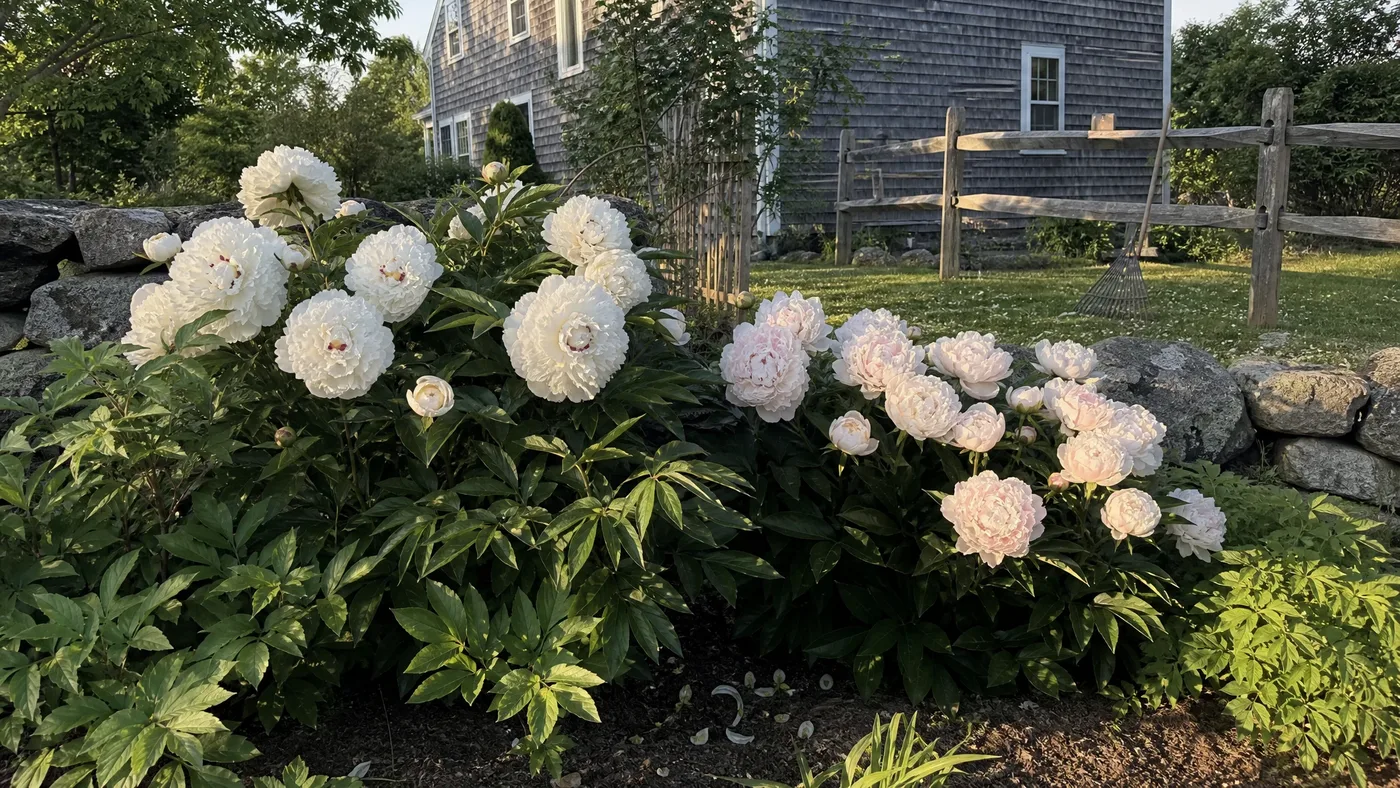
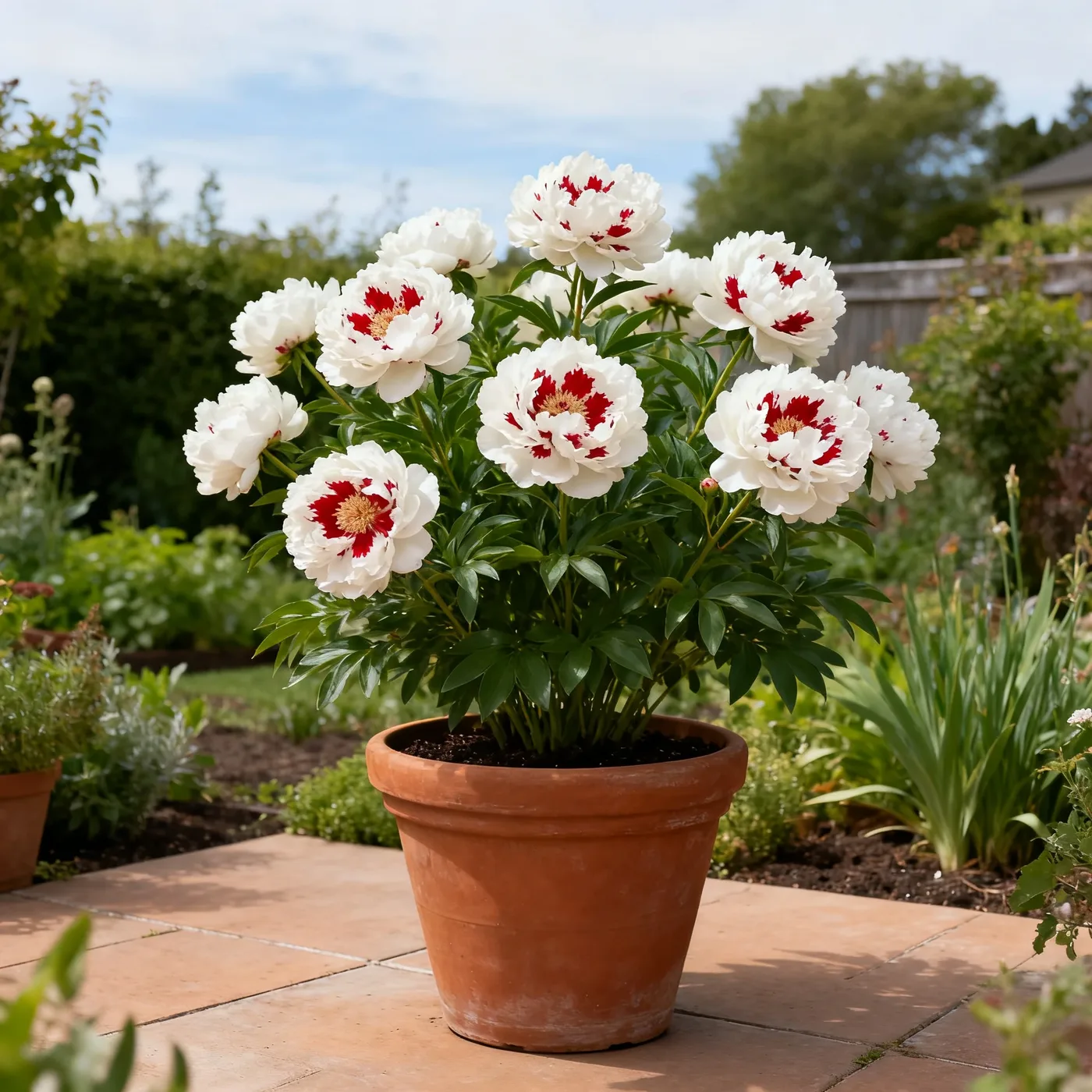
Color is the main material you are buying, so look at what each plant really delivers. Festiva Maxima has very fragrant, fully double, white flowers with variable crimson flecking. The word that matters is variable. Some blooms carry only a few small marks near the center and others carry more, and you cannot order the pattern.
In a bed, the effect depends on distance. From across the yard the flower reads as a clean, heavy white, and the crimson disappears into it. Up close, on a path edge or at the front of a border, the flecks give the center a warm, hand-painted look. White also carries well at dusk, which suits a bed you see mostly in the evening.
In a vase the flecks become the feature, because people lean in to a cut peony and see every mark. We cover cutting stage and how long the blooms last in our guide to the Festiva Maxima bouquet, cutting stage and vase life.
One of the most common questions we get is whether the red flecks mean something is wrong. They do not. Flecking is part of how the cultivar is described, and the plant has no cure for it because it needs none.
The common advice to choose a white peony for a pure, unmarked white is worth questioning. Festiva Maxima is white with marks, and if you want a spotless flower you should say so before you buy.
Shirley Temple's Pink Fades Toward White
Shirley Temple is the color-changer, with rose-pink flowers that fade to buff-white, while the Conservation Garden Park describes large white double flowers blushed with pink. Those readings are less contradictory than they sound. They describe the same flower at different moments, pinker when it opens and paler as it matures.
That timing is what you are really buying. Each flower fades over its run in the garden, which is about two weeks for a peony plant as a whole, and we have no day count to give you. In practice you get a stretch where fresh pink blooms sit beside paler older ones, then a plant that reads as soft near-white.
Customers usually ask us whether the pink holds. It does not, and you should not buy the plant expecting it to. Buff-white is also not the same as the clean white of Festiva Maxima, so a border meant to be strictly white will look slightly off with Shirley Temple in it.
If you like gentle movement in a border, the fade is the whole appeal. If you want the same flower color on every day of the bloom window, choose the plant that does not change.
What Bloom Dates Mean for Your Calendar
The Conservation Garden Park lists both plants as blooming May to June, so on paper they share the same window. The North Carolina State Extension notes that each peony plant blooms for about two weeks in late spring to early summer. Do not buy Shirley Temple expecting it to stretch the season past Festiva Maxima. Your local weather and zone will move both plants earlier or later together, and a warm spring shortens the show for both.
Planning Around a Two-Week Window
For a wedding, graduation or garden party, treat peony timing as a forecast with a margin. Keep a simple notebook for the first few seasons, with the date the first flower opens and the date the last petals drop. After two years you will know your own window far better than any listing can tell you. Your local extension service can say which weeks are typical for your area.
Cutting for the House
If you grow for cut flowers, the two weeks are your harvest. Stagger by buying plants of different ages, not just different cultivars, because the clump that has settled longer carries more flowers at once. That is also why a single young plant of either type gives you only a few stems in its first good year.
Stakes, Rings and Rain for Festiva Maxima
Both plants are fully double, and a heavy double flower on a thin stem leans when it takes on rain. Festiva Maxima may need support. The Shirley Temple listing asks for a sheltered position, which tells you wind and wet matter there too. Our position is simple: budget for support on either plant and treat it as part of the purchase price.
Choosing Rings, Cages and Single Stakes
A grow-through ring or cage is the best fit for a clump. The stems come up through it and hide it by the time buds form. Match the ring to the plant's size: Festiva Maxima spreads 2–3 feet, and Shirley Temple spreads up to 3 feet, so Shirley needs the wider hoop. In a cutting row, single stakes with loose ties give each stem its own hold, though they cost more time than money.
The gear itself is a small expense next to the plant. Buy it in winter, while you are ordering, so it is on hand before the shoots come up. If you order Festiva Maxima from us, add the ring to the same shopping list.
- Set the ring or cage over the clump in early spring, while the shoots are still short.
- Push the legs in firmly so the frame does not rock in wind.
- Tie single stems loosely, never in a tight bundle that crushes the foliage.
- Leave the support in place until the foliage is cut back.
Fragrance Near the Path
Fragrance is the payoff for staking where you walk. Festiva Maxima is described as very fragrant, and Shirley Temple as fragrant, so both reward a spot beside a path, gate or bench. A supported bloom stays up at nose height instead of lying in the mud after a storm, which is the difference between smelling the flower and stepping around it.
Which Garden Gets Festiva Maxima and Which Gets Shirley Temple
Match the plant to the garden, then to the site. The trade-offs are mostly about color, cold, wind and room.
Formal Beds and Cottage Borders
A formal bed wants repetition, and Festiva Maxima delivers a consistent white that does not change over the bloom window. A cottage border is more forgiving, and Shirley Temple's blush-to-white fade mixes easily with roses and other perennials. Our landscape ideas for Festiva Maxima peonies show how the white one works beside other plantings.
Cutting Rows and Small Yards
For a cutting row we lean to Festiva Maxima, because the white is steady and the scent is described as very fragrant. In a small yard the two take similar room, though Shirley Temple is a little lower, which helps toward the front of a border. Festiva Maxima is deer tolerant per the Conservation Garden Park, so it is a safe pick where deer wander.
Sun, Wind and Cold
Both do best in full sun, and the extension notes that overly shaded sites can inhibit flowering. Shirley Temple is the one flagged for a sheltered position, so give it the quieter corner. For cold, Shirley Temple is listed to zone 3 and Festiva Maxima to zone 4, so a zone 3 garden should look to Shirley Temple first.
Spending Your Peony Budget on Festiva Maxima or Shirley
If you are buying one plant, we would choose Festiva Maxima for most gardens: it is very fragrant, and its white stays the same through the whole bloom window. Choose Shirley Temple first if you garden in zone 3, or if the pink-to-white fade is exactly what you want in a cottage border. Spend first on the plant, then on a ring, then on room, since a crowded peony disappoints at any price.
Over a decade the money is mostly spent on day one, and the clumps grow toward the sizes in the table above. Our plain planning advice is to buy one of each in alternating years, so the spend is spread out and the bed builds a long bloom sequence.
Festiva Maxima
Nursery-grown Festiva Maxima in sizes from 4 Quart, shipped to your door.
From $38.99
Shop Now →Festiva Maxima in our rows gets full sun and deep, well-drained soil, which is how we would plant it ourselves if we were choosing between it and Shirley Temple for a bed we meant to keep. Being a small grower-run business, we only ship plants we would plant ourselves, and that holds for either peony. Once you have settled on one, see the plants we have ready.